How to Build Muscle as a Woman: Workout Plan, Protein and Signs It Works
 Written by Patrick UtschinskiNASM Certified Personal Trainer
 Reviewed by Rose TateHealth Educator & Nutrition Coach
Summary
- Train 3-4 times a week and do about 10 or more hard sets per muscle group each week, adding weight over time.
- Eat about 1.6 g of protein per kg of body weight a day; more adds little extra muscle.
- Beginners can lose fat and build muscle at the same time with a small deficit and enough protein.
- You feel stronger in weeks; visible muscle usually takes 2-3 months of consistent training.
On this page
- How Women Build Muscle: The 4 Basics
- Best Workout to Build Muscle as a Woman (4 Days)
- How Much Protein Do You Need to Build Muscle?
- Body Recomposition for Women: Lose Fat and Build Muscle at the Same Time
- How Long Does It Take to Build Muscle?
- Signs You Are Gaining Muscle (Not Fat)
- Supplements: Do Women Need Creatine?
- What Slows Muscle Growth the Most
- Conclusion
- FAQs
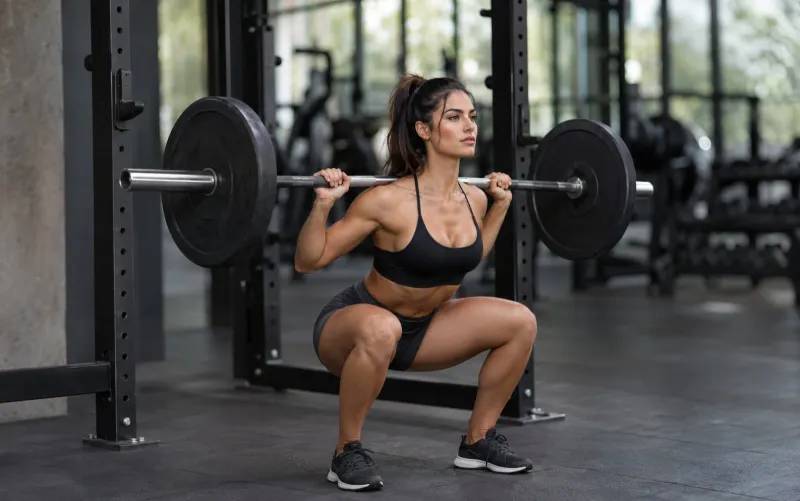
To build muscle as a woman, lift progressively heavier weights 3-4 times a week, do about 10 or more hard sets per muscle group each week, eat around 1.6 grams of protein per kilogram of body weight a day and sleep well. Women gain muscle at about the same relative rate as men, but from a smaller starting point, so the result is a stronger, leaner and more defined body, not bulk. Below you will find a 4-day muscle building workout for women, how much protein you need, how long it takes and the signs that you are gaining muscle, not fat.
How Women Build Muscle: The 4 Basics
Muscle grows when you give it a reason to adapt and the materials to rebuild. That comes down to four things:
- Progressive overload. Add weight, reps or sets over time. Doing the same workout with the same weights for months keeps you where you are.
- Enough volume. More weekly sets lead to more muscle growth, and about 10 or more sets per muscle group a week is a good target[2].
- Enough protein and energy. Your body needs building material: protein and enough total calories (more on this below).
- Recovery. Muscles grow between workouts, so sleep and rest days are part of the program.
The good news: when women and men follow the same program, they gain muscle at a similar relative rate, and untrained women may even gain upper-body strength faster[1]. Because women start with less muscle mass, the absolute gains are smaller, which is exactly why "bulky" is not a realistic risk. For the myths around this, read weight training for women: benefits and myths.
Best Workout to Build Muscle as a Woman (4 Days)
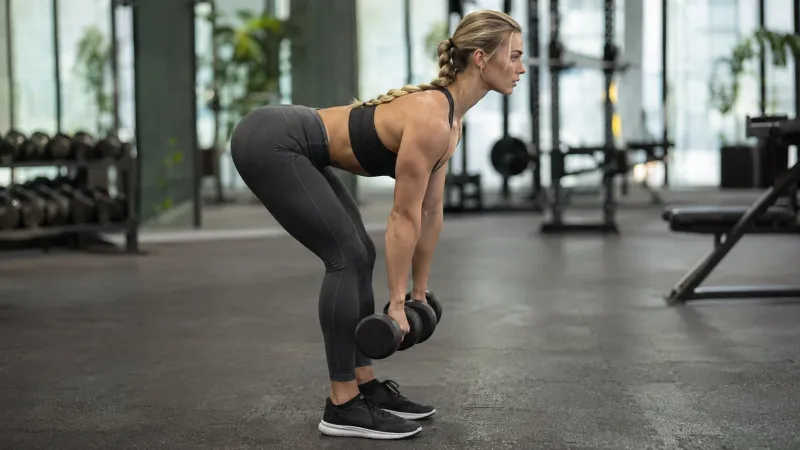
This upper/lower split trains every muscle group twice a week with about 10-12 hard sets each. Train on Monday, Tuesday, Thursday and Friday, or any 4 days with no more than 2 in a row. Rest 1.5-2 minutes between heavy sets and about 1 minute on smaller exercises.
Day 1: Upper Body A
| Exercise | Sets x reps |
|---|---|
| Dumbbell bench press | 3 x 8-10 |
| One-arm dumbbell row | 3 x 10-12 per arm |
| Seated dumbbell shoulder press | 3 x 8-12 |
| Lat pulldown | 3 x 10-12 |
| Dumbbell lateral raise | 2 x 12-15 |
| Biceps curl + triceps pushdown | 2 x 12-15 each |
Day 2: Lower Body A
| Exercise | Sets x reps |
|---|---|
| Goblet squat or barbell back squat | 3 x 6-10 |
| Romanian deadlift | 3 x 8-10 |
| Hip thrust | 3 x 10-12 |
| Walking lunge | 2 x 10 per leg |
| Standing calf raise | 2 x 12-15 |
| Plank | 2 x 30-45 s |
Day 3: Upper Body B
| Exercise | Sets x reps |
|---|---|
| Incline dumbbell press | 3 x 8-12 |
| Seated cable row | 3 x 10-12 |
| Assisted pull-up or close-grip pulldown | 3 x 6-10 |
| Push-up | 2 sets, stop 2 reps before failure |
| Rear delt fly | 2 x 12-15 |
| Hammer curl + overhead triceps extension | 2 x 12-15 each |
Day 4: Lower Body B
| Exercise | Sets x reps |
|---|---|
| Barbell hip thrust (heavier) | 4 x 6-10 |
| Bulgarian split squat | 3 x 8-10 per leg |
| Leg press | 3 x 10-12 |
| Lying or seated leg curl | 3 x 10-12 |
| Cable glute kickback | 2 x 12-15 per leg |
| Dead bug | 2 x 8 per side |
Only have 3 days? Do 3 full-body sessions instead, like the beginner weight training routine, and add a fourth set to the main lifts. Training at home? Dumbbells, a bench and resistance bands cover most of these exercises, and our home workouts show bodyweight options.
How Heavy and How Hard?
Light and heavy weights build muscle about equally well, as long as the sets are hard, while heavier loads build more maximal strength[3]. In practice, use weights you can lift for 6-15 reps and stop each set when you have about 1-3 good reps left. If a set feels easy, it does not count as a hard set.
How to Apply Progressive Overload
Write down every set. When you hit the top of the rep range in all sets with good form, add a small amount of weight next time and drop back to the bottom of the range. Lower-body lifts usually progress faster than upper-body lifts, and small jumps of 1-2 kg are normal for exercises like shoulder presses.
Lifting will not make you bulky, but lifting with a plan will make you stronger. Focus on squats, hip hinges and presses, track your numbers, and try to beat them a little every few weeks.
Patrick UtschinskiNASM Certified Personal TrainerHow Much Protein Do You Need to Build Muscle?

A large meta-analysis of 49 studies found that extra protein improves muscle and strength gains from resistance training, but the benefit levels off at about 1.6 grams per kilogram of body weight per day[4]. That is a practical daily target:
| Body weight | Protein per day (about 1.6 g/kg) | Per meal (4 meals) |
|---|---|---|
| 50 kg (110 lb) | 80 g | 20 g |
| 60 kg (132 lb) | 95 g | 24 g |
| 70 kg (154 lb) | 110 g | 28 g |
| 80 kg (176 lb) | 130 g | 32 g |
Foods that give you about 20-30 grams of protein: 100 g of cooked chicken breast, a can of tuna, 200 g of Greek yogurt plus a handful of nuts, 3 eggs with a slice of cheese, 150 g of firm tofu, or one scoop of whey or plant protein powder. Spread your protein over 3-4 meals instead of eating most of it at dinner.
Calories matter too. To build muscle as fast as possible, eat at maintenance or slightly above it. If you also want to lose fat, keep the deficit small, as described in the next section.
Body Recomposition for Women: Lose Fat and Build Muscle at the Same Time
Body recomposition means gaining muscle and losing fat at the same time, so your shape changes even if your weight barely moves. It works best for beginners, women returning after a break and anyone with some fat to lose. In studies, 10 weeks of resistance training added about 1.4 kg of lean weight and removed about 1.8 kg of fat[5]: almost no change on the scale, but a visibly different body.
- Eat at maintenance or in a small deficit (about 200-300 calories a day below maintenance).
- Keep protein at about 1.6 g per kg of body weight.
- Lift 3-4 times a week with progressive overload, and add walking or light cardio on other days.
- Judge progress by measurements, photos and strength, not only the scale.
If your main goal is weight loss, follow our workout plan for women to lose weight instead.
How Long Does It Take to Build Muscle?
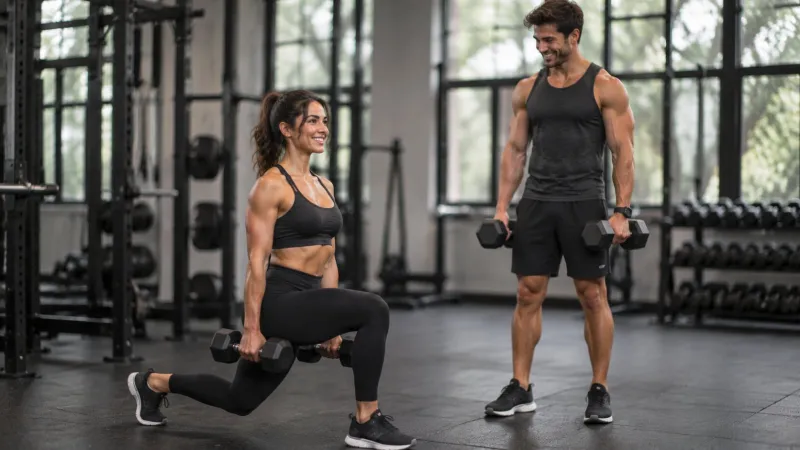
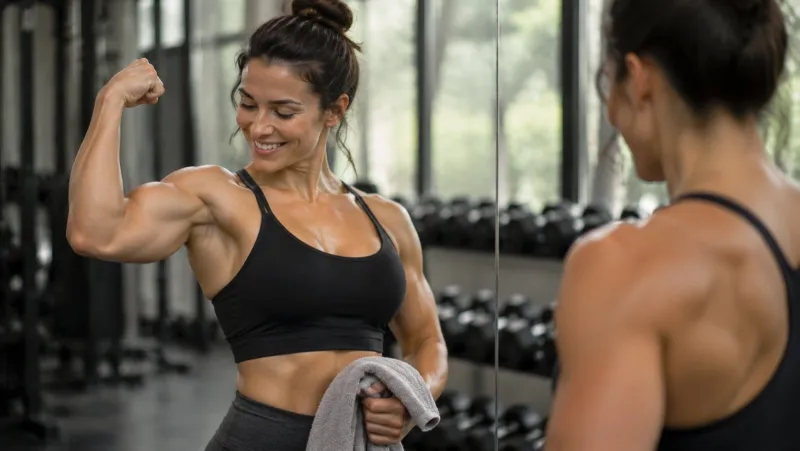
You will usually feel stronger within the first 2-4 weeks. Most of that early progress comes from your nervous system learning to use the muscles you already have. Measurable muscle growth takes longer: in most studies, beginners show clear gains after 8-12 weeks of consistent training, like the 1.4 kg of lean weight after 10 weeks mentioned above[5]. Visible changes in the mirror usually follow after 2-3 months, and big changes take a year or more.
Progress is fastest in the first year and slows down later, which is normal. It is never too late to start: women in their 50s and 60s still build muscle and strength with regular training, as we explain in our section on strength training for women over 40 and 50.
Signs You Are Gaining Muscle (Not Fat)
| What you notice | Gaining muscle | Gaining fat |
|---|---|---|
| Strength in the gym | Weights and reps go up | No change |
| Waist measurement | Stays the same or gets smaller | Grows |
| Arms, shoulders, glutes, thighs | Firmer and more defined | Softer |
| Clothes | Tighter around arms or thighs, looser at the waist | Tighter at the waist |
| Body weight | Stable or rising slowly | Rising faster |
Measure your waist, hips, upper arm and thigh every 2-4 weeks at the same spot, take photos in the same light once a month and keep a training log. Together they tell you much more than the scale alone.
Why Am I Gaining Weight When Working Out?
A small weight increase in the first weeks of training is common and usually not fat. Muscles that are working hard store more carbohydrate and water, and sore, recovering muscles hold extra fluid for a few days. If your waist is not growing and your lifts are going up, keep going. If your waist is growing steadily, check your calorie intake.
Supplements: Do Women Need Creatine?
You do not need supplements to build muscle. Food comes first. Two products are well researched and can make life easier:
- Protein powder is simply a convenient way to reach your daily protein target.
- Creatine monohydrate is one of the most researched supplements. Long-term use is considered safe for healthy people, and it helps you train harder and may support recovery[6]. In women before menopause, it appears to improve strength and exercise performance, and research is also looking at benefits after menopause[7]. The usual dose is 3-5 grams a day, taken at any time. It may add a little water weight in the first weeks.
For dosage, side effects and how to choose a product, see our full guide to creatine for women.
If you are pregnant, breastfeeding, have kidney problems or take medication, talk to your doctor before taking any supplement.
What Slows Muscle Growth the Most
- Not eating enough. A big calorie deficit and low protein make building muscle very hard.
- No progression. The same weights for months mean the same body.
- Too little sleep. Aim for 7-9 hours, because recovery happens while you rest.
- Program hopping. Changing the plan every week makes progress impossible to track. Stick with one program for at least 8-12 weeks.
- Sets that are too easy. Stopping a set with 6 or more reps left gives your muscles little reason to grow.
Strength training is one of the best things women can do for long-term bone health. If you have osteoporosis or are pregnant, it is often still recommended, but agree the exercises and the load with your doctor.
Rose TateHealth Educator & Nutrition CoachConclusion
Building muscle as a woman is simple, but it takes patience: train 3-4 times a week, do about 10 or more hard sets per muscle group, add weight step by step, eat about 1.6 g of protein per kg of body weight and sleep well. You will feel stronger within weeks and see the changes within a few months. And you will look stronger and more defined, not bulky.
FAQs
How can a woman build muscle at home?
With adjustable dumbbells, a bench and resistance bands you can do almost all the exercises in this plan. Without equipment, use harder bodyweight variations like Bulgarian split squats, single-leg hip thrusts and push-ups, and take every set close to failure.
How much protein does a woman need to build muscle?
About 1.6 grams per kilogram of body weight a day, for example around 95 grams for a 60 kg woman. Higher amounts add little extra muscle for most people.
How long does it take for a woman to build visible muscle?
Usually 2-3 months of consistent training to notice it in the mirror, and 6-12 months for clear changes. You will feel stronger much sooner.
Can you build muscle after 50?
Yes. Muscles respond to training at any age. Start with lighter weights, progress gradually and pay extra attention to protein and recovery.
Should women take creatine?
It is optional. Creatine monohydrate at 3-5 grams a day is well researched and considered safe for healthy adults, and it can help you train harder. Ask your doctor first if you have kidney problems or are pregnant.
Will building muscle make me heavier?
Possibly a little, but muscle is denser than fat, so you can weigh the same or slightly more and still look leaner and wear smaller sizes.
Sources
- Roberts BM, Nuckols G, Krieger JW. Sex differences in resistance training: a systematic review and meta-analysis. J Strength Cond Res. 2020
- Schoenfeld BJ, Ogborn D, Krieger JW. Dose-response relationship between weekly resistance training volume and increases in muscle mass: a systematic review and meta-analysis. J Sports Sci. 2017
- Schoenfeld BJ et al. Strength and hypertrophy adaptations between low- vs. high-load resistance training: a systematic review and meta-analysis. J Strength Cond Res. 2017
- Morton RW et al. A systematic review, meta-analysis and meta-regression of the effect of protein supplementation on resistance training-induced gains in muscle mass and strength in healthy adults. Br J Sports Med. 2018
- Westcott WL. Resistance training is medicine: effects of strength training on health. Curr Sports Med Rep. 2012
- Kreider RB et al. International Society of Sports Nutrition position stand: safety and efficacy of creatine supplementation in exercise, sport, and medicine. J Int Soc Sports Nutr. 2017
- Smith-Ryan AE et al. Creatine supplementation in women's health: a lifespan perspective. Nutrients. 2021
This article is for general information only and is not a substitute for professional medical advice. Talk to your doctor before starting a new exercise program. See our medical disclaimer.