Walking vs Running for Weight Loss: Which Is Better?
 Written by Patrick UtschinskiNASM Certified Personal Trainer
 Reviewed by Rose TateHealth Educator & Nutrition Coach
Summary
- Running burns about twice as many calories per minute as brisk walking and about 10-30% more per mile.
- A brisk 40-minute walk burns about the same as a 20-minute run, with much less impact on your joints.
- For the same energy spent, walking and running bring similar health benefits; consistency and diet decide weight loss.
On this page
- Walking vs Running at a Glance
- Calories Burned Walking vs Running
- Which Is Better for Weight Loss?
- Walking or Running to Burn Belly Fat?
- Incline Walking vs Running
- Health Benefits Beyond Weight Loss
- Which Should You Choose?
- 8-Week Walk-to-Run Plan
- How to Burn More Calories on Every Walk or Run
- Conclusion
- FAQs
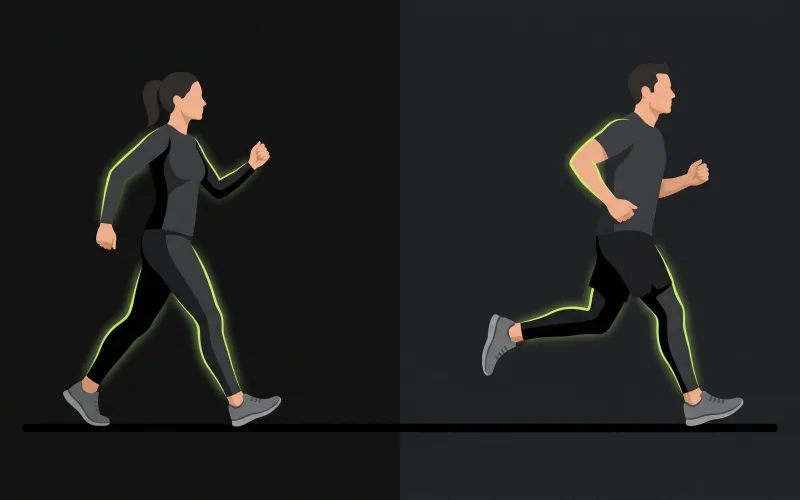
Running burns roughly twice as many calories per minute as brisk walking, and about 10-30% more per mile. But for weight loss, the better choice is the one you can keep doing week after week. A brisk 40-minute walk burns about the same as a 20-minute run, puts far less stress on your joints and is easier to fit into a busy day. Below you will find the real numbers, what research says about weight loss from each, and a simple plan if you want to move from walking to running.
Walking vs Running at a Glance
| Brisk walking | Running | |
|---|---|---|
| Calories in 30 minutes (160 lb person) | about 175 | about 310-340 |
| Calories per mile (160 lb person) | about 100 | about 110-125 |
| Impact on joints | Low | High |
| Time needed for the same calorie burn | About 2x longer | Shorter |
| Easy to start and keep up | Very easy | Needs gradual build-up |
| Best for | Beginners, heavier people, joint problems, daily habit | Fitter people, short on time, faster results |
Calories Burned Walking vs Running
The table shows estimated calories for 30 minutes at three body weights. The numbers are based on MET values from the 2024 Adult Compendium of Physical Activities[1][2], the standard reference researchers use to estimate energy cost. One MET is roughly one calorie per kilogram of body weight per hour, so a heavier person burns more doing the same activity.
| Activity (30 minutes) | MET | 130 lb | 160 lb | 190 lb |
|---|---|---|---|---|
| Walking, 2.8-3.4 mph (moderate) | 3.8 | 112 | 138 | 164 |
| Brisk walking, 3.5-3.9 mph | 4.8 | 142 | 174 | 207 |
| Very brisk walking, 4.0-4.4 mph | 5.5 | 162 | 200 | 237 |
| Uphill walking, 6-10% grade | 7.0 | 206 | 254 | 302 |
| Running, 5 mph (12 min/mile) | 8.5 | 251 | 308 | 366 |
| Running, 6 mph (10 min/mile) | 9.3 | 274 | 337 | 401 |
Use the table above to estimate calories for your weight.
Per Mile: Running Still Burns More
A popular claim says walking and running burn the same calories per mile. That is only roughly true. For a 160 lb person, walking a mile at 3-3.5 mph burns about 90-100 calories, while running a mile at 5-6 mph burns about 110-125. Running uses more energy per step because you push your body off the ground with every stride. The difference per mile is modest, but the difference per minute is large, which is why running is the time-efficient option.
If you are new, start with brisk walking and then add short jogging intervals. Your heart and lungs adapt faster than your tendons and joints, so build the running part slowly.
Patrick UtschinskiNASM Certified Personal TrainerWhich Is Better for Weight Loss?
Weight loss comes from a calorie deficit: burning more than you eat over weeks and months. Both activities help, and research suggests running may have a small extra edge. In a 6.2-year follow-up of thousands of runners and walkers, people who ran lost more weight than people who walked for the same estimated energy spent, and the gap was largest in people with the highest starting weight[3].
In real life, though, the total matters more than the type:
- Consistency wins. Five 45-minute walks a week burn more than one run you skip after a bad week.
- Diet decides most of the result. One 30-minute run burns about 300 calories, which is easy to cancel with one snack. Pair exercise with a modest calorie deficit and enough protein.
For a full weekly structure that combines cardio with strength work, see our workout plans for weight loss.
Walking or Running to Burn Belly Fat?
Neither walking nor running targets belly fat directly: you cannot choose where your body loses fat first. Belly fat goes down as your overall body fat goes down, so the activity that helps you keep a steady calorie deficit is the one that will shrink your waist. Adding two strength sessions a week helps you keep muscle while you lose fat, which matches the official recommendation for adults[5]. If you are unsure where to start with weights, read our guide to weight training myths and facts.
Incline Walking vs Running
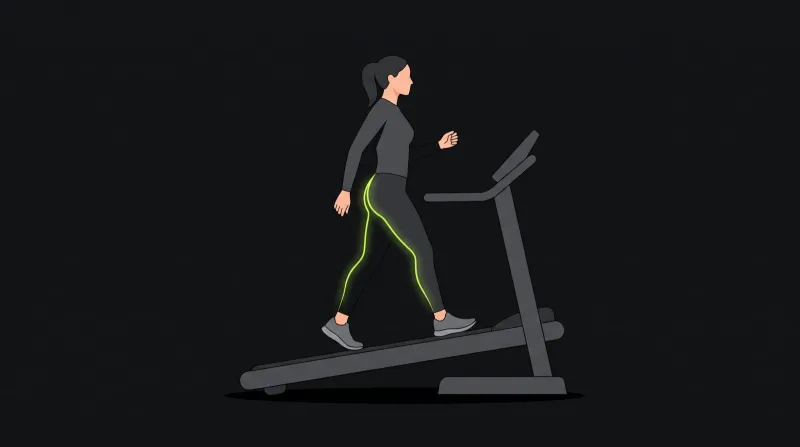
Incline walking is the middle ground. Walking uphill at a 6-10% grade has a MET value of about 7.0[1], close to a slow 5 mph jog (8.5)[2], but with much less impact on your knees and ankles. On a treadmill, set a pace you can hold while talking in short sentences and an incline of 6-10%. Hold the rails only for balance: leaning on them reduces the work your legs do and the calories you burn.
Health Benefits Beyond Weight Loss
When people spend the same amount of energy, walking and running bring very similar health benefits. In a large study of runners and walkers, equal energy expenditure from walking and running produced similar reductions in the risk of high blood pressure, high cholesterol and diabetes[4]. So if you cannot or do not want to run, you are not missing out, you simply need to walk longer.
The Physical Activity Guidelines for Americans recommend at least 150 to 300 minutes of moderate-intensity activity, like brisk walking, each week, plus muscle-strengthening activity at least 2 days a week[5].
Which Should You Choose?
- Choose walking if you are a beginner, carry extra weight, have joint pain or simply enjoy it. Aim for brisk walks of 30-60 minutes most days.
- Choose running if you are already fit, have little time and your joints feel good. Two or three 20-30 minute runs a week go a long way.
- Mix both if you want the best of each: walk-run intervals, or brisk walks on most days with one or two runs a week.
8-Week Walk-to-Run Plan
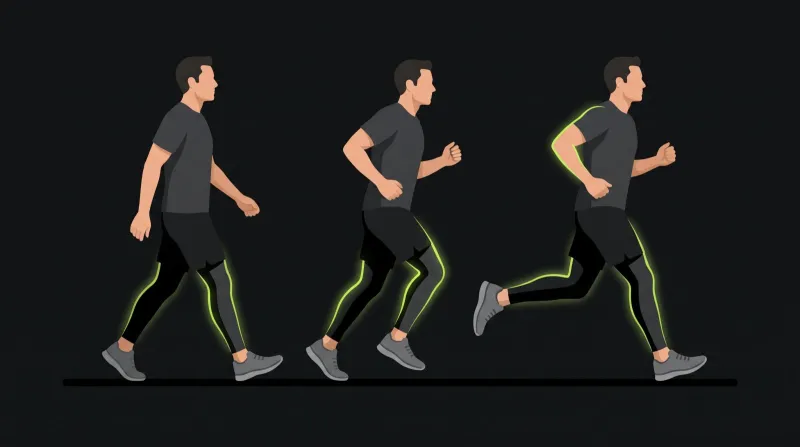
Do 3 sessions a week with a rest day in between. Start each session with 5 minutes of brisk walking and finish with 5 minutes of easy walking. If a week feels hard, repeat it before moving on.
| Week | Main set | Total time |
|---|---|---|
| 1 | 8 x (1 min easy jog + 2 min walk) | 24 min |
| 2 | 6 x (2 min jog + 2 min walk) | 24 min |
| 3 | 5 x (3 min jog + 2 min walk) | 25 min |
| 4 | 4 x (5 min jog + 2 min walk) | 28 min |
| 5 | 3 x (8 min jog + 2 min walk) | 30 min |
| 6 | 2 x (10 min jog + 2 min walk) + 5 min jog | 29 min |
| 7 | 2 x (15 min jog + 2 min walk) | 34 min |
| 8 | 25-30 min continuous easy jog | 25-30 min |
Keep the jog slow enough to talk. Speed comes later; the goal of these 8 weeks is to let your tendons and joints adapt.
How to Burn More Calories on Every Walk or Run
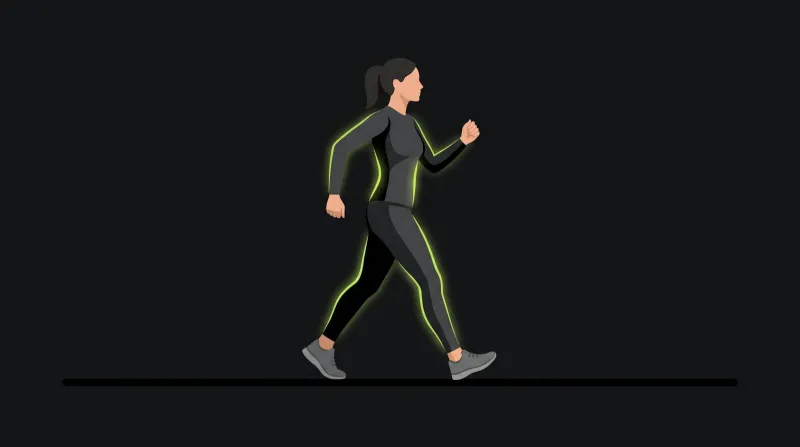
- Walk faster. Going from 3 mph to 4 mph raises the calorie burn by almost half.
- Add hills or incline. A 6-10% incline nearly doubles the burn of flat moderate walking.
- Use intervals. Alternate 1-2 minutes fast with 1-2 minutes easy.
- Move more during the day. Extra daily steps add up, and they also support a healthy metabolism. Read more in how to speed up your metabolism naturally.
- Add strength training. No gym needed: try our home workouts twice a week.
Walking is one of the safest ways to start losing weight if you carry extra weight or have joint problems. If running leaves pain in your knees, shins or feet that lasts into the next day, reduce the load and get it checked.
Rose TateHealth Educator & Nutrition CoachConclusion
Running burns about twice as many calories per minute and slightly more per mile, and research links it to a bit more weight loss. Walking delivers the same health benefits for the same energy spent, is gentler on the body and is easier to keep up. For most people the winning plan is simple: walk briskly most days, add incline or short running intervals as your fitness improves, and support it with a modest calorie deficit and strength training.
FAQs
Is it better to walk for 40 minutes or run for 20 minutes?
They burn about the same. A 160 lb person burns roughly 230 calories in a 40-minute brisk walk and about 225 calories in a 20-minute run at 6 mph. Choose the walk if you want less impact, and the run if you are short on time.
Is walking as good as running?
For health, yes, as long as you walk longer. Equal energy spent walking and running gives similar reductions in the risk of high blood pressure, high cholesterol and diabetes. For weight loss, running has a small edge per minute.
Can you lose weight just by walking?
Yes. Brisk walking for 45-60 minutes most days, combined with a modest calorie deficit, is enough for steady weight loss for most people. Adding incline or strength training speeds up results.
How long should I walk to lose weight?
Aim for at least 150-300 minutes of brisk walking a week, for example 30-45 minutes on 5-7 days. More minutes and a faster pace mean more calories burned.
Does incline walking burn more than running?
Usually not. Walking at a 6-10% incline burns less than running at 5-6 mph, but it comes close and is much easier on your joints, which makes it a great option for many people.
Sources
- 2024 Adult Compendium of Physical Activities: Walking
- 2024 Adult Compendium of Physical Activities: Running
- Williams PT. Greater weight loss from running than walking during a 6.2-yr prospective follow-up. Med Sci Sports Exerc. 2013
- Williams PT, Thompson PD. Walking versus running for hypertension, cholesterol, and diabetes mellitus risk reduction. Arterioscler Thromb Vasc Biol. 2013
- U.S. Office of Disease Prevention and Health Promotion: Top 10 Things to Know About the Physical Activity Guidelines for Americans
This article is for general information only and is not a substitute for professional medical advice. Talk to your doctor before starting a new exercise program. See our medical disclaimer.